


2019 - 20



Friday 15th November 2019, Sheldonian Theatre
An Evening of Wagner in memory of Dr. Paul Coones
Conducted by Jan Latham-Koenig
Featuring our recently gifted Wagner Tuba instruments
Led by Katalin Oldland
Wagner Overture from Die Meistersinger
Wagner Prelude and Liebestod from Tristan und Isolde
Wagner Ride of the Valkyries from Die Walkure
Two preludes from Wagner's Lohengrin
Bruckner Adagio from Symphony No.7
A review of this concert can be found here:
REVIEW: Oxford University Orchestra Michaelmas Term Concert (oums.co.uk)
Sophie Littlewood reviews the OUO Concert (conducted by Jan Latham-Koenig) which took place at the Sheldonian Theatre, 15/11/19
Last Friday, we were treated to a whistle-stop tour of one of the most controversial figures in music: Wagner. The Oxford University Orchestra showed once again their technical prowess, under the masterful hand of Jan Latham-Koenig. The concert started with the Ride of the Valkyries, with the famous leitmotif played out in an impressive display of orchestra ensemble. The brass stood out amongst the crisp strings, but soon warmed up to embrace the drama of the music, complete with virtuosic percussion. Next, the only non-Wagner piece of the night: Adagio from Bruckner’s Symphony No. 7, complete with Wagner Tubas. The rich harmony and lyricism was matched by the full-bodied timbre of the lower strings and strings in a display of almost excessive romanticism. The orchestra breathed as one creature, but almost edged towards aimlessness – after all, this was a piece in anticipation of Wagner’s death – but the orchestra pushed through with energy towards a false climax that almost seems to beckon in early Schoenberg. After an excellent flute solo, we however were instead treated to a delicate ending with only a hint of conclusion.
The last two pieces before the interval were both from Lohengrin, Wagner’s opera of medieval romance and the famous “Here Comes the Bride”. First up was the Prelude to Act III, which opened with impressive control and a delightful solo from the leader, Katalin Oldland. The melodious wind perfectly matched the high strings that would have otherwise been a little too high-pitched. There was nothing to complain about here, as Wagner knew how to make use of an orchestra and OUO knew how to respond. That being said, the next piece, the Prelude to Act III, provided a much-needed change of pace. The orchestra embraced this opportunity to give a dance-like performance, complete with excellent control from the wind section.
After the interval, it was time for the revolutionary Tristan und Isolde, which no tour of Wagner would be complete without. The orchestra played the concert arrangement, the Prelude and Liebestod, of which the opening “Tristan chord” was no doubt recognised by every music student. The performance was truly excellent, even despite the unfortunate addition of a very contemporary drumbeat from directly outside the Sheldonian during the quietest moment. Thankfully, this remix moved on in time to hear the harps. The penultimate piece was Siegfried’s Funeral March from Götterdämmerung, another opera of the Ring cycle. The Wagner Tubas were on full display, and the orchestra exuberantly embraced the drama. At points it felt as if Latham-Koenig was fighting to keep the energy up, but his efforts paid off as the tension, compounded by the excellent oboe and clarinet performances, was matched by superb percussion, vibrant snare and triangle included. Finally, Der Meistersinger. By this point, the orchestra was truly on top form, and started the way that Valkyries should have, an hour ago. The excitement of the detached strings and chirpy woodwind built as the drama moved across the orchestra. Wagner’s musical genius was evident as the two melodies intertwined in a delightful dichotomy, and finally rose to the glorious unison finale. All in all, a great end to a great concert.
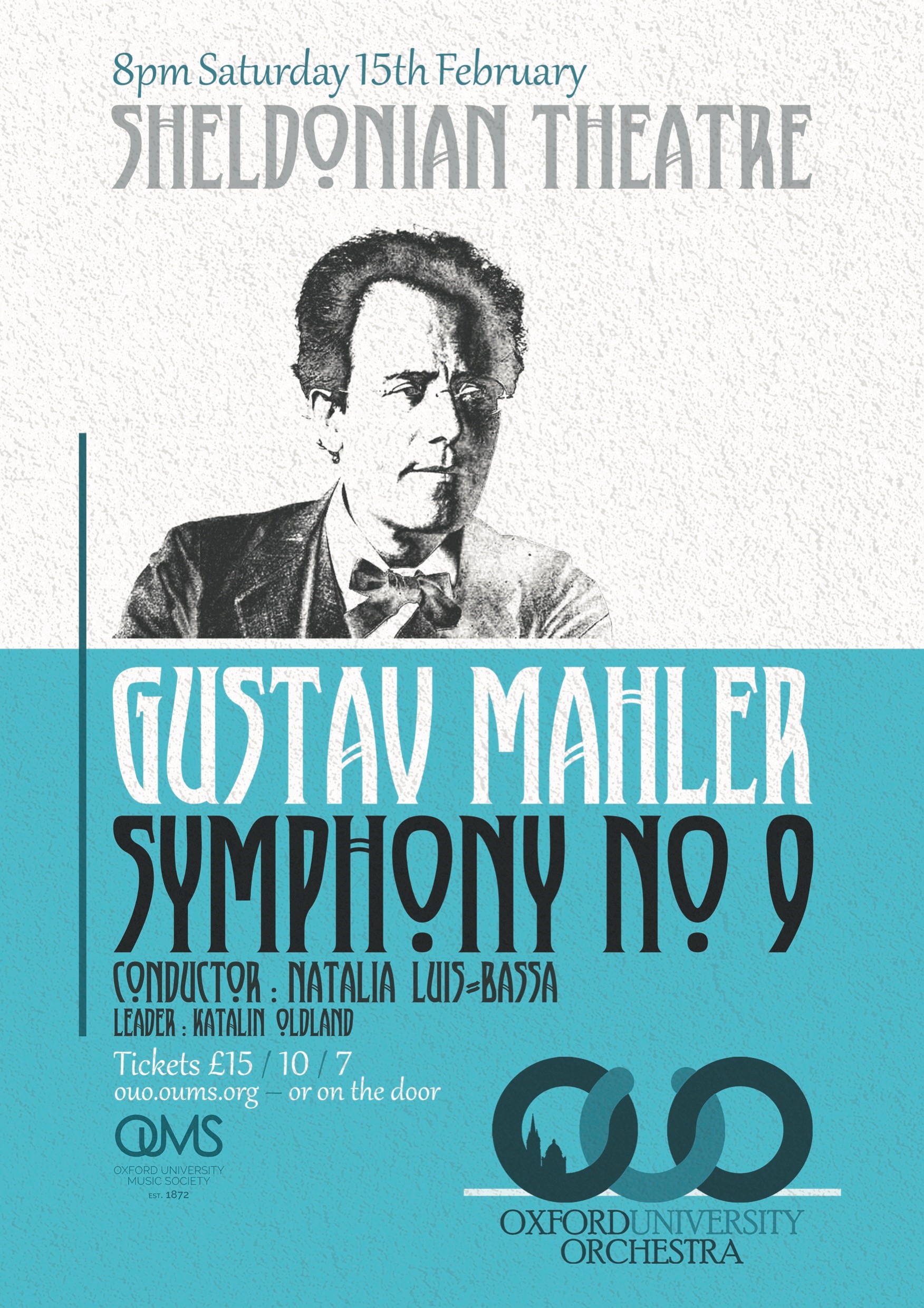
Saturday 15th February 2020, Sheldonian Theatre
Conducted by Natalia Luis-Bassa
Led by Katalin Oldland
Mahler Symphony No.9
Reviews of this concert can be found here:
REVIEW: OUO – Mahler’s 9th Symphony (oums.co.uk)
Oxford University Orchestra - Mahler Symphony No 9 - Daily Info | Daily Info
String tremolandos and flutter-tongued flutes
With Storm Dennis raging outside the Sheldonian, what would be more appropriate inside than a spot of Mahler to accompany the tempest? And indeed the composer's instruction for the second movement: 'Etwas tappisch und sehr derb' [somewhat clumsy and very rough] does rather summon up Shakespeare's magician on his post-tempest island.
But this was the Ninth Symphony, containing both an Adagio and an Andante movement, so constant fireworks were not on the menu, though with an orchestra numbering 83, including five percussionists and two harps, we surely had the firepower for them. The opening notes for cello and horns found awkwardness of playing from the latter (atypical, since the horns thereafter were very good; particularly their section leader Benjamin Hartnell-Booth) and then we were away with strings and massed brass. The trumpets with mutes had plenty of work soon enough – one of their number, Nick Budd, wrote the laudably copious programme notes, full of imaginative speculation about Mahler's references to life, death and the universe. The tuba player Nick Ingram was also busy with a huge mute that looked a bit like the 1968 Apollo Programme lunar module. The coda to the movement is remarkable in that Mahler fines down his orchestra to chamber music size, as though tacitly admitting that by this late stage of his career he no longer needed enormous resources to express himself adequately.
I was interested in the approach of conductor Natalia Luis-Bassa who holds posts, among others, at Wellington College and the Royal College of Music. I've seen her described as 'dynamic' and 'flamboyant' but here her approach was low-key, minimalist even; employing truncated gesture, seemingly more focused on macro concerns like tempo and rhythm than in micro-directing the sub-sections of the orchestra.
The great spans of the two outer movements, on occasion erupting in monumental climaxes with dynamic contrast, complement each other, but the intention of the two inner ones remains enigmatic. The Rondo Burlesque often runs along at a fairly furious pace, and our young players demonstrated they were not at all fazed by the required virtuosity. The middle passage featured high string tremolandos and flutter-tongued flutes (a little scratchy in tone here). The hushed intensity of the final Adagio, its beginning suggesting clear links to the famous Adagietto of the Fifth Symphony, offers fine scope to the violins. It was interesting to observe how, at the introduction of the second theme, the first violinists applied individually quite widely varying degrees of vibrato to the strings. When they were joined by full brass and woodwinds, the packed tiers of Sheldonian audience were reminded how no orchestra but Mahler's ever sounds quite like this, as we swept on to the conclusion full of glowing optimism.
So here was a concert to warm the cockles of the heart on a wild evening, particularly since Sarah Jenkinson and her acolytes always offer a wide-smiling welcome. Next up at the Sheldonian is the OU Philharmonia this Thursday, with Sibelius and Grieg.
Reuben Tendler reviews the Oxford University Orchestra’s performance of Mahler’s 9th Symphony, conducted by Natalia Luis-Bassa, which took place at the Sheldonian Theatre, 15/2/20.
It’s Saturday night, and the weather outside is miserable. The damp forces of transatlantic nature harbour the great, the good, and the cold into the Sheldonian Theatre. What better way to escape the harsh gales of Broad Street than to sit nearby on a rigid wooden step, listening to an hour and a half of music about premature death. Dennis brings the sturm; Mahler brings the drang.
As the pre-concert announcer reminds the patrons, the Sheldonian was not built to modern standards. It seems that its acoustic properties are not quite apt for the full thrust of symphonic massacre that the OUO present: the horns regularly sound forced and tardy in loud passages, and high string passages mostly disappear into thin air. But on other occasions, the resonance of the hall affords marvellous clarity. The bassoon and clarinet soli at the start of the 2nd movement, and the contrabassoon’s weavings at its close emit a marvellous warmth. And so too do the outbursts of trumpets in the 1st movement, releasing copious amounts of musical tension.
Conductor Natalia Luis-Bassa is strict with time, driving both the ländler of the 2nd movement and the burleske of the 3rd to points of structured frenzy. But this rigidity affects the music’s fluidity, and the players’ obvious need to follow their musical intuitions. Most notably on edge is the somewhat-stumbling flute and horn duet in the 1st movement, yet I must admit that this passage is rather odd in the first place.
After the silence that follows the last dying-away of quiet string melodies of infallible sensitivity, OUO’s brilliant musicians are aptly lauded with fervid applause, and the sound of the audience waking from various levels of music-induced dazes. As the listeners depart, the rumble of the storm seeps through the windows, but the music lingers in the head a little while longer.
Monday 9th March 2020, Sheldonian Theatre
Featuring the Oxford University Jazz Orchestra and the strings of the Oxford University Orchestra
An evening of classic and contemporary tunes arranged for big band and strings
The Oxford University Jazz Orchestra are excited to present their 2020 project: World on a String. They’ll be collaborating with Oxford University Orchestra’s strings to provide an evening of high-quality jazz, from the well-known songs of Sinatra and Fitzgerald to premieres of new compositions and arrangements commissioned for the event.
This concert will showcase the talents of some of the university’s best musicians, bringing together two of the Oxford University Music Society’s flagship ensembles.
Both have toured worldwide – most recently to Japan, Thailand and New York – and have a reputation for exciting and vibrant performances.
The ensembles’ alumni include British trumpeter Mark Armstrong, Canadian jazz vocalist Diane Nalini, saxophonists Carlos Lopez Real and Idris Rahman, and English National Opera conductor Steve Higgins (amongst many others).World on a String will bring together an eclectic mix of music in this unprecedented collaboration between the two multi award-winning ensembles.
We are trying to identify the full programme for this concert, if you have any details or pictures please let us know.
Friday 26th June 2020, Online
Creative Direction by William Emery
Video Production by Damon Falck
Audio Production by Toby Anderson and Andrew Liu
Bizet Farandole from L'Arlesienne Suite No.2
You can watch the video of this virtual performance here:
OUO Virtual Performance - Farandole | By Oxford University Orchestra | Facebook

